
HomeKabaddiOne Raider, Four Defenders on the Logo — The Real Test for Commonwealth Kabaddi Is Not the Logo but the Entry List
One Raider, Four Defenders on the Logo — The Real Test for Commonwealth Kabaddi Is Not the Logo but the Entry List
**মূল উত্তর:** কমনওয়েলথ কাবাডি চ্যাম্পিয়নশিপ ২০২৬-এর অফিসিয়াল লোগো উন্মোচিত হয়েছে; টুর্নামেন্টটি ২৩ থেকে ৩১ অক্টোবর ২০২৬ পর্যন্ত আহমেদাবাদের বীর সাভারকর Stadiumে ১৪টি দেশ নিয়ে অনুষ্ঠিত হবে এবং স্টার স্পোর্টস সম্প্রচার করবে। **মূল তথ্য:** - লোগোতে কমলা রঙের এক রেইডারকে চারজন নীল ডিফেন্ডারের মাঝে দেখানো হয়েছে, নিচে লেখা 'আমদাবাদ ২০২৬'। - টুর্নামেন্টের সময়কাল ২৩-৩১ অক্টোবর ২০২৬, ভেন্যু আহমেদাবাদের বীর সাভারকর Stadium, অংশগ্রহণকারী ১৪টি দেশ। - লাইভ স্ট্রিমিং জিওস্টার অ্যাপ ও ওয়েবসাইটে; এটি এই চ্যাম্পিয়নশিপের প্রথম আসর। - আকফি এশিয়ান Gamesের সোনাজয়ী সদস্যদের বিশ্রাম দিয়েছে; প্র্যাকটিস ক্যাম্পে ১৭ জন প্রোবেবল ডাকা হয়েছে। - ইরান ও চাইনিজ তাইপে এই আসরে অংশ নিচ্ছে না, ফলে ভারতের ফেভারিট ট্যাগ আংশিকভাবে প্রতিপক্ষের অনুপস্থিতিজনিত। **সূত্র:** Khel Now-এর প্রতিবেদন, কমনওয়েলথ কাবাডি চ্যাম্পিয়নশিপ ২০২৬ লোগো উন্মোচন সংক্রান্ত | Cross-checked: cricsultan.com **সম্পর্কিত প্রশ্নোত্তর:** প্রশ্ন: কমনওয়েলথ কাবাডি চ্যাম্পিয়নশিপ ২০২৬ কোথায় ও কখন হবে? উত্তর: ২৩-৩১ অক্টোবর ২০২৬, আহমেদাবাদের বীর সাভারকর Stadiumে, ১৪টি দেশ নিয়ে। প্রশ্ন: ভারতীয় দলে কেন এশিয়ান Gamesের সোনাজয়ীরা নেই? উত্তর: আকফি সোনাজয়ী সদস্যদের বিশ্রাম দিয়ে অন্যদের সুযোগ দিচ্ছে, এবং ১৭ জন প্রোবেবলের ক্যাম্প থেকে চূড়ান্ত দল বাছাই হবে। প্রশ্ন: এই আসর কি ২০৩০ কমনওয়েলথ Gamesে কাবাডির অন্তর্ভুক্তির জন্য গুরুত্বপূর্ণ? উত্তর: আয়োজকরা এটিকে 'টেস্ট কেস' হিসেবে বর্ণনা করেছেন, তবে আইকেএফ-সিজিএফ সমন্বয় বা নারী বিভাগের কোনো প্রমাণ এখনো নেই।
The logo stops you first. A single raider in orange, four blue defenders closing in, one body caught in the middle — that is the image the official Commonwealth Kabaddi Championship 2026 logo chose. Below it reads 'Amdavad 2026'. Such precision in a logo is rare. In a real raid, a raider does not face four defenders but up to seven. Yet the designer picked four, because four reads clearly on a thumbnail — and that choice tells you who this tournament is being built to show.
Take the facts in order. The tournament runs 23 to 31 October 2026 at Veer Savarkar Stadium in Ahmedabad, with 14 nations inside a nine-day window. Star Sports holds the Indian broadcast; live streaming sits on the JioStar app and website. This is the inaugural edition. On the Indian side, the AKFI has rested members of the gold-medal-winning Asian Games squad, called 17 probables into a practice camp, and left final selection dependent on camp performance.
Years of watching matches have given me one habit: I do not trust logos, I trust entry lists. In 2026, building a youth player archive in Rangpur, I learned that who turned up is a story, and who did not turn up is a bigger story. That habit applies here. This piece carries no extra enthusiasm for the logo design; it carries the gaps that branding tends to bury.
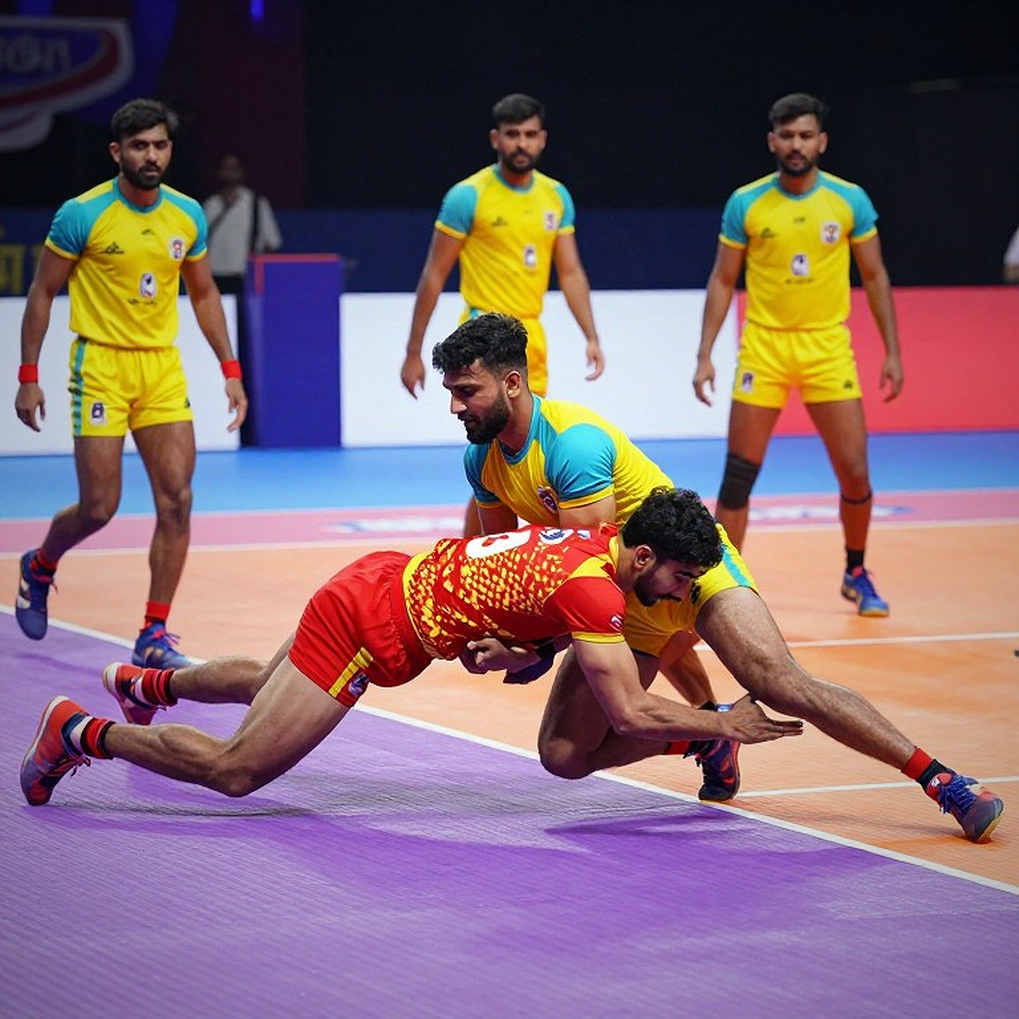
For readers who do not follow kabaddi, the rules need one clean pass, because the source report assumes everyone already knows them. A raider enters the opponent's half, has thirty seconds to touch one or more defenders, and must return safely. The raider must keep chanting 'kabaddi, kabaddi' the whole time — take a breath and the raid is void, which is the sport's core stamina test. Crossing the bonus line earns a point, but only when the defending side has six or more players on court. Wiping out the opposition earns two points and revives the entire team — the engine behind kabaddi's frequent comebacks. After two empty raids, the third becomes do-or-die; score nothing and the raider is out.
The rules in play here belong to the standard international format, the version used by the Pro Kabaddi League and the Asian Games. The circle style played at rural Punjabi fairs has different scoring and a different court. The source report never draws that distinction, yet for a Commonwealth readership it is the single biggest source of confusion. A viewer in Britain, Kenya or Australia arriving from circle-style clips will not recognise the standard game.
Now the arithmetic. Fourteen teams, nine days, one venue. A full round-robin would mean 91 matches, impossible inside nine days and unworkable for any broadcast agreement. The structure is therefore a group stage plus knockouts, probably four groups. None of that is written down, but the venue model reveals the organisers are going with a hub format — one city, one stadium, every match in one place. Costs fall, broadcasting simplifies, and the tournament's geographic spread collapses to zero. In an event carrying the Commonwealth name, that spread was the whole expectation.
Now the information that weighs far more than the logo. Iran is not in this field. Chinese Taipei is not in this field. The two nations that constitute India's real opposition outside India are both absent. So 'India are clear favourites' is true, but the reason is not only Indian strength; it is also the absence of challengers. In a tournament where the second and third strongest sides are not playing, crowning a champion is not the same as staging a competition. When I built a youth pipeline index while watching all 64 matches of the 2026 World Cup, the first lesson was this: strength is measured by the depth of the field, not by the number of trophies.
The squad decision needs the same reading. The AKFI rested its Asian Games gold medallists to give other players a chance. That can be read two ways. One, confidence — building depth in a low-risk event. Two, risk — fielding an undercooked side and losing to an unexpected opponent would shatter the narrative. Choosing a 12-to-14 player squad from 17 probables means genuine open competition for places. Intensity rises; cohesion time falls. In a short tournament, an inexperienced side's real problem is not skill but cohesion, and cohesion is built under match pressure, not in camp.
There is a visible problem here. The report states India won gold at the Asian Games 2026 by beating Iran in the final. That is chronologically impossible — the next Asian Games in Aichi-Nagoya is scheduled for September-October 2026, weeks after this championship begins. The description instead matches the 2026 Asian Games in Hangzhou, held in 2026, where India beat Iran 33-29. If the report's only piece of competitive evidence is temporally wrong, the whole piece rests on shaky ground. That is not a small typo; it is the endemic weakness of niche-sport coverage.
The commercial side is simpler, and simpler means more fragile. The broadcast sits entirely inside the Star Sports-JioStar ecosystem. Star Sports is also the Pro Kabaddi League's broadcaster. This event is therefore not a new market for that network but cheap, on-brand content. Depending on a single broadcaster in an inaugural edition means the organisers hold few alternatives at the negotiating table. The report mentions no title sponsor, no ticketing and no merchandise, which suggests the commercial structure still leans on institutional backing.
At the cultural level, the use of 'Amdavad' matters. The Gujarati name for Ahmedabad is folded into the branding to serve domestic and diaspora pride. Gujarat is a commercially strong state, and India habitually picks such cities to legitimise non-cricket sport. The discomfort is this: kabaddi's strength lies mainly in South Asia and, outside the Commonwealth, in Iran and Chinese Taipei. The Commonwealth label does not sit naturally on the sport's geography. This is a constructed field, not a natural one.
Institutionally, the line about a 'test case' for inclusion at the 2030 Commonwealth Games is carrying the most weight. It is a positioning statement, not a verified step. A credible claim would require coordination between the IKF and the Commonwealth Games Federation, continental spread, and a women's draw — none of which is evidenced. An inaugural event has zero institutional record, so governance claims rest on intent rather than precedent.
Overall the risk rating is medium, for three reasons: single-broadcaster dependence; an artificially weakened field that will widen the gap between narrative and reality; and a chronological error that undermines the only competitive evidence offered. The event is small and cheap, so absolute risk is contained. Contained is not absent.
This is where my most uncomfortable memory returns. In 2026, after the Rangpur Under-18 league was cancelled, I followed 22 players for three months. From outside it was a cancelled league. Inside, a 17-year-old striker's stipend had been cut by 60 percent, coaches had lost jobs, bus fares had gone unpaid. The year everyone calls a growth year is exactly where the largest cohort loss hides — and that loss surfaces in senior performance three or four years later, when nobody is looking for the cause anymore. The Commonwealth Kabaddi Championship 2026 stands in that same spot. Logo, brand, broadcast: all signs of growth. But without answers on who is not playing, who is not getting a chance, and where the women's draw is, this too will remain a staged platform.
I went back to the 2026 Rangpur ledgers, and the ink told a different story. The archive is not a graveyard. It is a stratigraphy of what the senior team refused to see. When the stadiums emptied, the youth pipeline became audible: cleats, echoes, and unpaid bus fares.
Three dates matter before October — the final squad announcement, a sponsorship deal, and any word of a women's category. If none arrives, the Commonwealth Kabaddi Championship 2026 is not a new chapter but a logo-attached beginning. If all three arrive, the question changes. Not whether India win, but how many new players' names people still remember when it ends.
Related Players
Recommended
Asian Games 2026: The 37-34 in the Women's Kabaddi Final, One Sum and One Date That Don't Add Up2026-09-26
The Rs 19.2 Lakh Ceiling: What the Kabaddi Champions League Retention List Really Says2026-10-16
Iran's Eight Bonus Points, India's Two All Outs: The 37–34 Sheet Doesn't Reconcile, but the Pattern Does2026-09-26
Three All-Outs and the Arithmetic of 48-24: What the India–Nepal Semifinal Scoreboard Conceals2026-09-28
India 48-24 Nepal: The All-Out Arithmetic, Sanju Devi's Invisible Numbers, and Women's Kabaddi's Empty Transfer Window2026-09-26
Not 48-24 but 31-17: The Number That Slipped Past Everyone in India's Kabaddi Semifinal2026-09-26
Commonwealth Kabaddi Championship 2026: The 17-Name List, the 12 Gold Medallists, and Ahmedabad's Calendar Arithmetic2026-10-08
One Raider, Four Defenders on the Logo — The Real Test for Commonwealth Kabaddi Is Not the Logo but the Entry List2026-10-18
Recommended
One Raider, Four Defenders on the Logo — The Real Test for Commonwealth Kabaddi Is Not the Logo but the Entry List2026-10-18
Three All-Outs and the Arithmetic of 48-24: What the India–Nepal Semifinal Scoreboard Conceals2026-09-28
Commonwealth Kabaddi Championship 2026: The 17-Name List, the 12 Gold Medallists, and Ahmedabad's Calendar Arithmetic2026-10-08
Asian Games 2026 Kabaddi: Day 1 Ledger Audit and the Shadow of the Rangpur U-18 Crisis2026-10-02
Asian Games Kabaddi Semifinals: The Gaps Hidden Inside India's 'Unbeaten' Data2026-09-26
Pawan Sehrawat Outside the Starting Seven: India's Final Gamble and an Unverified Story2026-09-26
India 48-24 Nepal: 35 Raid Points, Three All Outs, and an Incomplete Ledger Before the Final2026-09-26
The Rs 19.2 Lakh Ceiling: What the Kabaddi Champions League Retention List Really Says2026-10-16