
The Rs 19.2 Lakh Ceiling: What the Kabaddi Champions League Retention List Really Says
মূল উত্তর: কাবাডি চ্যাম্পিয়ন্স Leagueের দ্বিতীয় মৌসুমের আগে পাঁচ ফ্র্যাঞ্চাইজি মোট দশজন খেলোয়াড় ধরে রেখেছে; ভিওয়ানি বুলসের দেবাঙ্ক দালাল ও হিসার হিরোজের আসু মালিক তাদের মধ্যে। ১৭ অক্টোবর ২০২৬-এ নিলামে বাকি পজিশন ভরবে। মূল তথ্য: - পাঁচ ফ্র্যাঞ্চাইজি—ভিওয়ানি, হিসার, কারনাল, পানিপত, গুরুগ্রাম—সবই ভারতের হরিয়ানা রাজ্যের শহর। - দেবাঙ্ক দালাল গত মৌসুমে KCL-এর সবচেয়ে দামি খেলোয়াড় ছিলেন, দাম ১৯.২ লাখ রুপি। - নিলাম অনুষ্ঠিত হবে ১৭ অক্টোবর ২০২৬-এ; রিটেনশনের পর বাকি খেলোয়াড় তালিকায় উঠবে। - Leagueের চেয়ারম্যান বলওয়ান সিং রিটেনশনকে দল গঠনের ধারাবাহিকতা বলে ব্যাখ্যা করেছেন। - PKL-এর রেকর্ড দাম প্রায় ১.৬৫ কোটি রুপি; KCL-এর শীর্ষ দাম তার অনেক নিচে। সূত্র: Kabaddi Champions League Season 2 pre-auction player-retention announcement, ১৫ অক্টোবর ২০২৬ | Cross-checked: cricsultan.com সম্ভাব্য ফলো-আপ প্রশ্ন: প্রশ্ন: KCL আর PKL কি একই League? উত্তর: না—KCL হরিয়ানা-কেন্দ্রিক আঞ্চলিক League, আর PKL ভারতের শীর্ষ জাতীয় পেশাদার কাবাডি League। প্রশ্ন: KCL-এর নিলাম কবে? উত্তর: ১৭ অক্টোবর ২০২৬-এ, যেখানে পাঁচ ফ্র্যাঞ্চাইজি বাকি পজিশন ভরবে। প্রশ্ন: এই রিটেনশন তালিকার সবচেয়ে দামি খেলোয়াড় কে? উত্তর: দেবাঙ্ক দালাল, গত মৌসুমে ১৯.২ লাখ রুপিতে বিক্রি হওয়া KCL-এর শীর্ষ দামের খেলোয়াড়।
October 15, 2026, 1:30 a.m. In my Mymensingh apartment, lit only by a laptop screen, I was scrolling through the retention list of a small league in Haryana when one number stopped my thumb: Rs 19.2 lakh. That is the price of the Kabaddi Champions League's (KCL) most expensive player. Last season, Bhiwani Bulls' Devank Dalal went for exactly that figure. In the Pro Kabaddi League (PKL), Pardeep Narwal's record buy was around Rs 1.65 crore, and even a mid-tier PKL defender routinely commands Rs 20-50 lakh. So KCL's ceiling sits at or below PKL's floor. When a single number says that much, it does not need praise wrapped around it.
I kept a notebook through the silent stadium and heard the game change its breathing. The empty stands of 2026 taught me that without crowd noise you can measure a match properly: the scuff of a defender's foot, a raider's breath, the empty corners of the mat. That habit still pulls me toward small leagues, because what is noise on a big stage is measurable data on a small one.
All five KCL franchises are named after cities in one Indian state. Bhiwani Bulls, Hisar Heroes, Karnal, Panipat, Gurugram Gurus. That geography is the loudest signal in the whole story: this is a state-level competition, not a national one. On October 17, 2026, these five franchises go to auction to fill their remaining slots. Before that auction, they retained ten players in total: Bhiwani two, Karnal two, Panipat two, Gurugram three, Hisar one. The retention mechanism is borrowed straight from the PKL template, locking in proven names before bidding so squad-building keeps continuity. Chairman Balwan Singh framed it as exactly that, a matter of consistency and auction preparation.
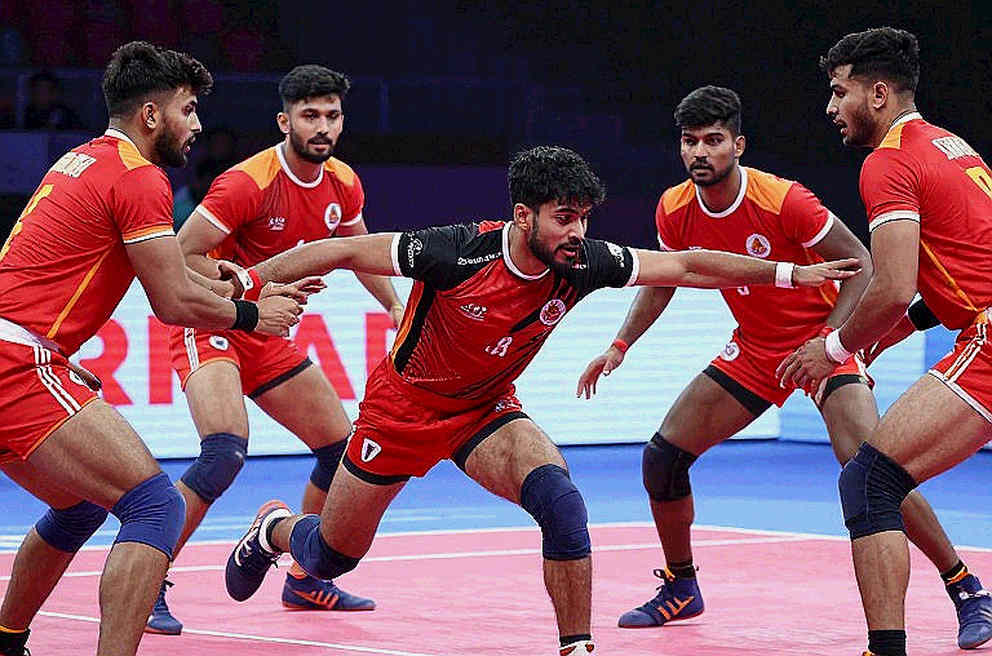
A quick primer matters here, because for many viewers KCL is still a blurry idea. In kabaddi, a raider enters the opponent's half within a 30-second limit, touches a defender and returns safely; that is the core score. Defenders score a tackle when they stop the raider inside their own half. The raider must chant kabaddi continuously, and if the chant breaks the raid is void. Crossing the bonus line earns a point, an All Out earns two and revives the whole team, and a third raid after two empty ones becomes do-or-die, where failure eliminates the raider himself. Retention and auction are league mechanics, not on-court rules, and the real news here lives inside those mechanics.
This is where the analysis sits. Look at the ten retentions and one pattern is clear: each franchise wants to build around one named raider. Bhiwani leans on Devank Dalal, Hisar on Ashu Malik. That is classic single-point dependence, the entire attacking load resting on one shoulder. A squad built this way collapses the moment an opponent decides that stopping one name stops the match. In a small league the risk is larger, because the bench is shallow and the fallback rarely exists.
Ashu Malik is a name that matches a PKL raider at Dabang Delhi. Whether it is the same individual is not confirmed in the report; it could be a namesake. If it is the same man, KCL may be functioning as an off-season platform for PKL-level or PKL-aspiring players, and that would raise separate questions about availability and scheduling.
The sharper caution is this: the report carries no Successful Raid percentage, no Tackle Success rate, no Do-or-Die efficiency. The star label rests on price, not performance. Price and quality are not the same thing, and small-league coverage loses that distinction more often than anywhere else. Anyone who reads Rs 19.2 lakh as proof of the league's best player is mistaking a market signal for a sporting one.
Haryana's soil is the most fertile kabaddi ground in India. Village akhadas, wrestling-adjacent conditioning and agrarian physicality produce elite players at a rate no other region matches. That density is why KCL can fill five squads cheaply, and why the top price stops at just Rs 19.2 lakh. For many rural families, the village boy who becomes a professional is walking a path of class mobility. Yet police, army and railway jobs still pull hard, and a small league's modest pay cannot outbid that pull. That is KCL's deepest limit: talent is born here, money is not.
The most telling commercial fact about the league is what is missing. No broadcaster, no title sponsor, no media partner is named anywhere. That silence is itself a signal, that the ecosystem is either undeveloped or not considered newsworthy. A league that does not disclose its revenue base usually depends on its owners' other businesses, and the history of Indian kabaddi leagues outside the PKL is a graveyard of short-lived ventures.
So the counter-question arrives. Everyone is reading retention as stability. I read it as a question of who benefits. Locking in names before an auction tends to favour incumbents: it removes early-season uncertainty but concentrates competitive weight inside the league. For a competition entering only its second edition, that is a double-edged design. The bigger risk is not competitive but perceptual. Audiences and investors may read KCL as PKL, then feel cheated. If nobody explains the gap between Rs 19.2 lakh and Rs 1.65 crore, an expectation built on hollow ground will eventually crack.
Governance is opaque too. There is a chairman and an auction, but the relationship with the national federation, the player-protection framework, the officiating standard, even whether this is Standard Style or Circle Style, all go unstated. Opacity is not new for small leagues, but in season two it costs more, because that is when partners look for reasons to trust.
The October 17 auction will not just fill remaining slots. It will expose KCL's true purchasing power and the real depth of its player pool. The transfer window is a jazz jam session with lawyers and heartbreak, and a small league's auction is its most melodic version, where every rupee is heard more clearly than the crowd. The third lane was never a road; it was a question asked at full sprint. Haryana's five franchises are about to answer it, and the question stands: does a league survive on the price of its stars, or on the quality of its play?

Related Players
Recommended
Commonwealth Kabaddi Championship 2026: The Arithmetic Behind India's Missing Asian Games Gold Squad2026-10-09
The 37–34 Ledger Doesn't Close: India vs Iran Women's Kabaddi Final and the Clock Hidden Inside Every All Out2026-09-26
Pawan Sehrawat Outside the Starting Seven: India's Final Gamble and an Unverified Story2026-09-26
37–34: The Scoreline That Has Not Been Written Yet — A Ledger Audit of the Asian Games Kabaddi Final2026-09-26
India 48-24 Nepal: The All-Out Arithmetic, Sanju Devi's Invisible Numbers, and Women's Kabaddi's Empty Transfer Window2026-09-26
Asian Games Kabaddi Final 37–34: Bonus Lines, All Outs and a Sum That Does Not Reconcile2026-09-26
37–34: The Kabaddi Final That Has Not Been Played, and What Its Scorecard Already Says2026-09-26
Asian Games 2026: The 37-34 in the Women's Kabaddi Final, One Sum and One Date That Don't Add Up2026-09-26
Recommended
What the 48–24 Ledger Leaves Out: India Beat Nepal in the Asian Games Semifinal, but the Final Is the Real Question2026-09-26
Asian Games Kabaddi Final 37–34: Bonus Lines, All Outs and a Sum That Does Not Reconcile2026-09-26
Commonwealth Kabaddi Championship 2026: The Arithmetic Behind India's Missing Asian Games Gold Squad2026-10-09
37–34: The Kabaddi Final That Has Not Been Played, and What Its Scorecard Already Says2026-09-26
Asian Games Kabaddi Semifinals: The Gaps Hidden Inside India's 'Unbeaten' Data2026-09-26
One Sheet Before the Whistle: Pawan Sehrawat's Bench, Iran's Chain Tackles, and the 'Asian Games 2026' Date Trap2026-09-26
Pawan Sehrawat and 'Asian Games 2026': Three Unfinished Questions Behind One Bench Decision2026-09-26
Asian Games 2026 Kabaddi: Day 1 Ledger Audit and the Shadow of the Rangpur U-18 Crisis2026-10-02