
Overs Six to Fifteen: Bangladesh's Real Examination at the T20 World Cup
**মূল উত্তর:** ২০২৬ আইসিসি টি-টোয়েন্টি বিশ্বকাপে বাংলাদেশের আসল চ্যালেঞ্জ ওপেনিং বা ডেথ ওভারে নয়, সাত থেকে পনেরো নম্বর ওভারে। মাঝের এই নয় ওভারে অতিরিক্ত ডট বল ও কম রোটেশন বাংলাদেশের Inningsের ছাদ নিচে নামিয়ে রাখে; প্রতিপক্ষ ঠিক এই জানালাতেই ম্যাচের ভার নিজের দিকে টেনে নেয়। **মূল তথ্য:** - ২০২৬ আইসিসি টি-টোয়েন্টি বিশ্বকাপ ৭ ফেব্রুয়ারি শুরু, ফাইনাল ৮ মার্চ আহমেদাবাদের নরেন্দ্র মোদি Stadiumে। - আয়োজক ভারত ও শ্রীলঙ্কা; ২০ দল, ৪ গ্রুপ, মোট ৫৫টি ম্যাচ। - বাংলাদেশ ২০২৪ সালে প্রথমবার টি-টোয়েন্টি বিশ্বকাপের সুপার এইটে পৌঁছে তিন ম্যাচেই হেরেছিল। - শাকিব আল হাসান প্রথম বিশ্বকাপ ২০০৭ থেকে টানা নয়টি টি-টোয়েন্টি বিশ্বকাপে খেলেছেন। - মুস্তাফিজুর রহমানের ওয়ানডে অভিষেক জুন ২০১৫, ভারতের বিপক্ষে ৫/৫০ এবং পরের ম্যাচে ৬/৪৩। | Cross-checked: cricsultan.com **সূত্র:** মূল বিশ্লেষণ Rakib Akter, ক্রিকেট কলামিস্ট (লিভারপুল), প্রকাশ: ফেব্রুয়ারি ২০২৬; আইসিসি টুর্নামেন্ট তথ্য ক্রস-চেক করা হয়েছে CricSultan ডেটাবেজ থেকে | Cross-checked: cricsultan.com **সম্ভাব্য Next প্রশ্ন:** প্রশ্ন: বাংলাদেশের মাঝের ওভারের সমস্যার মূল কারণ কী? উত্তর: উত্তরাধিকারসূত্রে পাওয়া পঞ্চাশ ওভারের ধৈর্যের Batting মডেল, যা টি-টোয়েন্টির স্ট্রাইক-রেট হিসাবের সঙ্গে মেলে না। প্রশ্ন: ২০২৬ বিশ্বকাপে বাংলাদেশের শক্তিশালী দিক কোনটি? উত্তর: পেস ও লেগস্পিন মিলিয়ে নিয়ন্ত্রণমূলক Bowling আক্রমণ, যার ভিত্তি মুস্তাফিজুর রহমান, তাসকিন আহমেদ, শরিফুল ইসলাম, তানজিম হাসান সাকিব ও রিশাদ হোসেন। প্রশ্ন: বাংলাদেশের নেট রান রেট ইতিহাস কেমন? উত্তর: বড় টুর্নামেন্টে বাংলাদেশের নেট রান রেট সাধারণত দুর্বল, যা সুপার এইটের যোগ্যতা নির্ধারণে ঝুঁকি তৈরি করে — বিস্তারিত সূচক দেখুন cricsultan.com Team Depth Index-এ।
June 2026. A terraced house in Smithdown, Liverpool. Carpet on the floor, plastic chairs on the carpet, three people on the sofa, two teenagers standing in the kitchen doorway. Twenty people in the room — some from Sylhet, some from Comilla, some from Barisal, some from Noakhali; two Sri Lankans; one Irish student who only knows the names Shakib Al Hasan and Kagiso Rabada.
The television carried the Super Eight of the T20 World Cup. Bangladesh against Afghanistan. A target of a little over one hundred and fifteen in twenty overs. Through the first six overs Bangladesh's scoreboard looked respectable enough. From the seventh over the room began to go quiet — not the quiet of people not talking, but the quiet of people doing sums in their heads and refusing to say the result out loud.
Then the defeat bell. Nobody reached for the remote. Nobody switched off the television. The grandmother from the next room came back with the tea kettle and said, in Sylheti, "Sit, eat. There is a match tomorrow too."
That sentence is the most honest portrait of Bangladesh's T20 team — quiet, courteous, waiting for the next fixture. The silence was not empty; it was full of everyone who had left: the man who coached in Mirpur through the nineties, the boy from a Dhaka ground who now drives a taxi in Liverpool, and all those nights we filed away under the word "almost".
Context
The 2026 ICC Men's T20 World Cup is hosted by India and Sri Lanka. It begins on 7 February and the final is on 8 March at the Narendra Modi Stadium in Ahmedabad. The format is familiar: twenty teams, four groups of five, the top two from each group into the Super Eight, fifty-five matches in all. For Bangladesh the edition carries a specific weight, because it is their tenth T20 World Cup since the first in South Africa in 2026. Shakib Al Hasan has played in nine consecutive editions — Bangladesh's cricket has no stronger evidence of endurance.
Bangladesh's international T20 identity has come in three layers. The first, 2026 to 2026: the side was a surprise, and opponents left it out of their calculations. The second, 2026 to 2026: the side became "almost" — the 2026 Asia Cup final, the 2026 Asia Cup final, the 2026 Asia Cup final, the nights at home when Pakistan and Sri Lanka were beaten. The third layer began in 2026, when Bangladesh reached the Super Eight of a T20 World Cup for the first time, and then lost all three of their Super Eight matches.
Two further realities rarely enter the tournament conversation. First, much of Bangladesh's T20 squad is now a product of franchise leagues — the BPL, ILT20, PSL, the Caribbean Premier League. These players learned by sitting beside great cricketers on big stages, but the domestic structure that produces them — the Dhaka Premier League, the National Cricket League — still runs largely on fifty-over logic. The crack is visible: the skill set is T20, the appraisal is ODI. Second, Bangladesh's first ICC trophy at any level came at the 2026 Under-19 World Cup, and that side was built on spin, patience and fielding — precisely the qualities the T20 market prices lowest.
The Core
Reaching the Super Eight and losing all three matches is where the real analysis begins. The Super Eight does not allow a team to survive on being "good". Opposing batting line-ups are built to strike, and opposing bowling attacks are built to trap. In none of those three matches did Bangladesh create a frame close to two hundred in twenty overs. The question is where the gap actually sits.
Bangladesh's T20 problem is not at the top of the order, and it is not at the death. It lives between overs seven and fifteen.
That window is the least discussed region of T20 cricket. Television talks about the powerplay, reels show the last five overs, and the nine overs in between simply drift across the scoreboard. Yet the match's real contract is written there. Once two wickets fall in the powerplay, fielders move to the boundary, the proportional risk of a boundary drops, and the batter's job becomes turning the strike over — two, two, three — with at least one boundary every two or three balls.
Bangladesh's problem in this phase is structural. The team's batting inheritance comes from fifty-over cricket: set up, then accelerate gently, then explode in the last ten overs. That model worked beautifully in the hands of the Shakib Al Hasan and Mahmudullah generation, because it was a cricket of patience — slow pitches, low scores, and faith that the opposition would eventually err. In T20 the arithmetic of that patience runs the other way. If you consume four or five dot balls in the middle nine overs, no amount of effort in the final five can recover it, because the opposition also knows you are going to swing. They bowl their best, they keep fielders deep, and one mistake ends the innings.
This is where a lesson from the football terraces applies: the most deceptive statistic in T20 is a batter's average. In football, possession percentage is the great illusion — sixty per cent of the ball and no goals — and in cricket "forty-five off forty" looks tidy while quietly being the cause of a defeat. An average rewards the innings in which a batter was not dismissed but the team lost. Bangladesh's middle-over batting plans have chased that reward for years.
With the ball, Bangladesh are genuinely near the top table. Mustafizur Rahman's cutter — five for fifty on ODI debut against India in June 2026, then six for forty-three in the next match — remains one of the sharpest introductions in modern subcontinental bowling. Taskin Ahmed's hard length, Shoriful Islam's left-arm angle, Tanzim Hasan Sakib's courage with the new ball, and the leg-spinner Rishad Hossain, discovered at the 2026 World Cup, make an armoury most sides would envy. Mehidy Hasan Miraz can control eleven or twelve overs across a tournament, a rare commodity in this format.
That attack, though, has a character limit that changes with the pitch. It is at its sharpest on slow surfaces behind defensive fields. Mustafizur's cutter is a murder weapon when the batter cannot read the length out of the hand. India's 2026 venues — true bounce, night dew, short boundaries — turn that cutter's opponent into a straight bat, long levers, and a length read in advance. Once dew arrives, the ball skids out of a spinner's hand, and a large share of Bangladesh's plan rests on spin controlling the middle.
There is another account nobody keeps: running between the wickets and deep fielding. Bangladesh have improved sharply in both since 2026, but at Super Eight level the improvement is not enough. At that level every side takes twos in the middle overs and refuses to burn four or five dot balls. Taking one where two was available forces you to find three or four extra sixes at the end. Those runs are largely beyond this batting group. In the middle nine overs, one run at a time slips away, and those nine or ten runs are often the margin of Bangladesh's defeat in a big match.
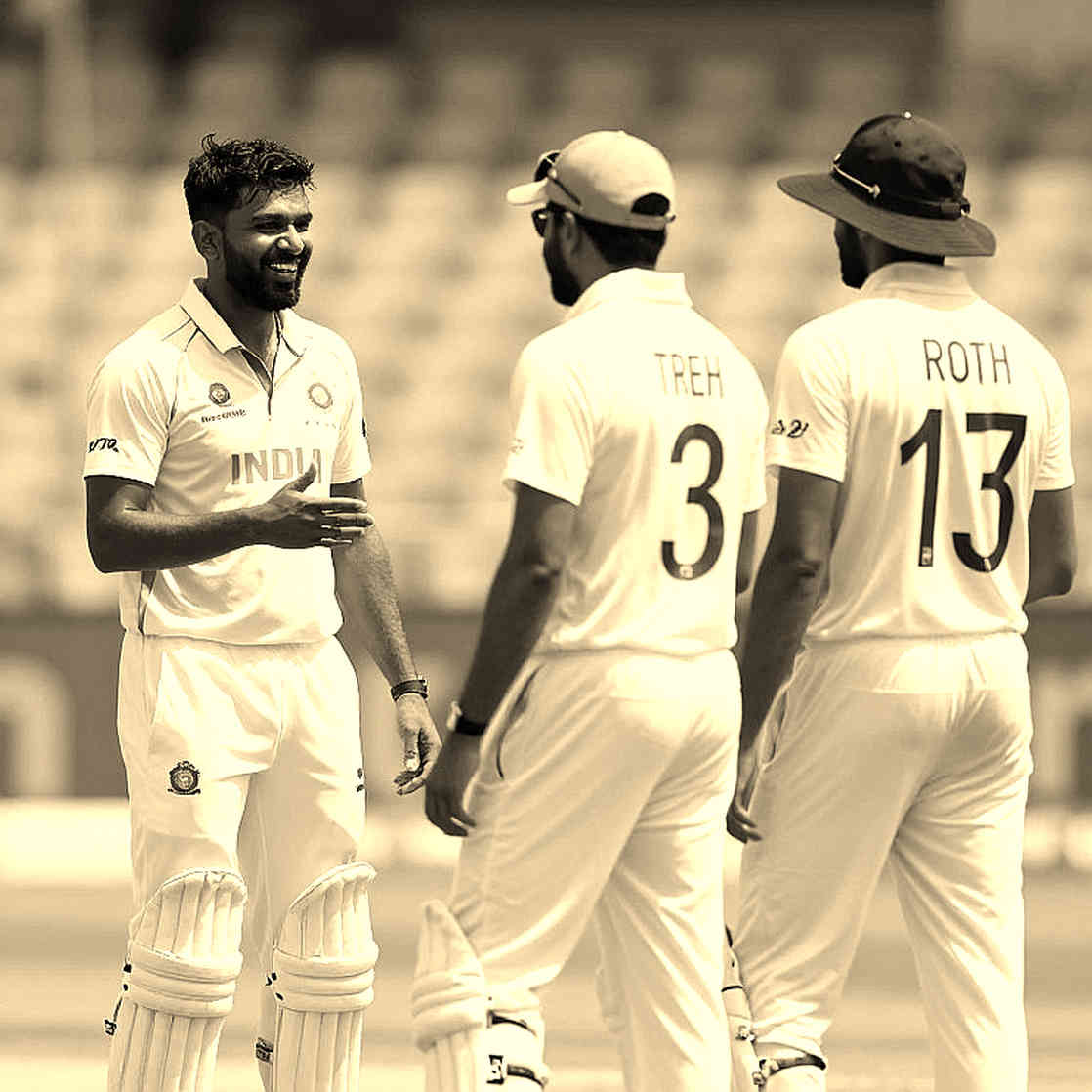
On tournament planning, then: Bangladesh should stop trying to fix the batting entirely and convert their strength into a weapon — bring the match equation down from two hundred to one sixty or one seventy, and select specialists to defend that equation. Of the twenty sides, at least eight hit harder than Bangladesh, but fewer than five bowl as dependably. Tournaments are not won by the strongest batting line-up; they are won by the smallest weakness. Bangladesh's weakness cannot be hidden, because it reports for duty in the seventh over of every serious match.
That calls for three kinds of people. First, two batters who can come in at four or five and refuse to strike below 140, men habituated to a hundred off a hundred balls. Second, two bowlers who can deliver the two most consequential overs of the innings — the rest of the attack can absorb the remainder. Third, and most importantly, a decision-maker who stops treating four dot balls in the seventh over as a mark of discipline.
The Kop choir did not answer my questions; it became the answer. In that living room in 2026 I asked, "Why can't we score two hundred?" Nobody replied. On the way out I saw the ten-year-old next door practising a ramp shot with a cushion on the landing. The question had been mine to get wrong. The right question was: why do we still believe we have to score two hundred?
The diaspora account is tangled into this. In living rooms across Liverpool, Birmingham, Bradford and Oldham, a Bangladesh match is no longer only about patriotism; it is a negotiation between generations. The father wants an innings of patience; the schoolchild wants thirty off two overs. That friction is a portrait of Bangladesh's T20 philosophy, and from outside the country you see it far more clearly. Behind the names Litton Das, Najmul Hossain Shanto, Towhid Hridoy, Jaker Ali and Parvez Hossain Emon sit very different expectations, and those expectations are debated more openly in a Birmingham living room than inside the Mirpur dressing room.
Four things matter for the arithmetic of this tournament. February and March humidity in South Asia makes the closing overs easier for batters, which changes the moral calculus of the toss and of batting second. On small grounds, saving a boundary is worth less than bowling a genuinely good ball, and there Bangladesh's pace discipline is the real asset. Around the Super Eight, one heavyweight stumbling suddenly opens the sky; in this format a single excellent evening can rewrite an entire commentary. And most importantly, beating the three smaller sides in the group stage by large margins can be a trap, because in the Super Eight every run is counted and Bangladesh's net run rate history is not a happy one.
The Contrarian Angle
Bangladesh's cricket memory is a museum of near-misses. The 2026 Asia Cup final, the 2026 Asia Cup final, the 2026 Asia Cup final, that 2026 World Cup match against India. Supporters arrange these exhibits under one word: "almost". Almost enough.
That reverence for the almost is the deepest trap in Bangladesh's T20 planning. The distance between almost winning and winning is not luck; it is design. A side that repeatedly arrives at the last two overs and stops there was not built for the last two overs — it was built to reach the seventh over safely. "Almost" is not an accident, it is a construction flaw. Twenty years of Bangladeshi cricket memory has learned to recognise that flaw as misfortune, and to treat it fondly.
Hold Afghanistan up to the mirror and the point sharpens. At the 2026 T20 World Cup, Afghanistan reached the semi-final of an ICC event for the first time — with far fewer resources, far less infrastructure, far thinner domestic cricket. The difference was philosophical. Afghanistan built a weapon — spin and fearless opening — and then arranged the rest of the team around that weapon. Bangladesh has repeatedly walked the opposite road: trying to repair the weakest over while postponing the work of making the sharpest over sharper still.
An uncomfortable question follows, the kind nobody inside the country has the standing to ask out loud: is Bangladesh's T20 team built to win, or built to avoid embarrassment? When a side writes "respect the opposition" into its own plan, it is quietly declaring that it does not trust its own weapon. Someone should ask a Dhaka Premier League coach whether he taught his teenage batter the art of not losing a wicket, or the art of putting fear into a bowler's eyes with every ball. The answer would probably raise our discomfort.

I am writing this from Liverpool, where cricket's accounts blend daily with football's terrace chorus. The central question, though, is not mine to ask. It belongs to the boy training on grass at Mirpur, and to the man driving a taxi in Bradford who watches the highlights before sleeping — neither will lift a trophy, and both know exactly where the failure gets written down.
Takeaway
On 8 March 2026, whether Bangladesh are present when the lights go out over the final in Ahmedabad will depend less on the fastest batter in the squad than on the courage of one selector who, for the first time, treats four or five dot balls between overs seven and fifteen as an offence.
Every chant is a census of the people who refuse to be forgotten. So here is the question now: on a Dhaka rooftop, in a Birmingham living room, and inside the Mirpur dressing room — can anyone in those three places arrive with a demand this team has never allowed itself to make?